
FINGER TEST PROBES & ACCESSIBILITY PROBES
ED&D finger test probes—also called test fingers, finger testing probes, or accessibility test probes—are used to evaluate protection against access to hazardous parts in electrical safety, product safety, and ingress-protection procedures. This product group includes jointed and articulated test fingers, rigid or unjointed finger probes, child finger probes, UL finger probes, appliance-specific probes, fingernail probes, rubber accessibility probes, and electrical contact indicators. Select the exact probe specified by the governing standard, figure, dimensions, articulation, force, stop-face geometry, and continuity requirements.

Finger Test Probe Configurations
Jointed, articulated, rigid, and unjointed models are available for procedures that specify different probe geometries or force application.
Standards-Based Selection
Test finger models differ by dimensions, stop face, palm simulator, articulation, materials, test force, and continuity provision.
Let us know the governing standard, required probe figure, whether continuity testing is needed, and whether your lab requires an ISO/IEC 17025 accredited calibration certificate.
Finger Test Probes for Electrical Safety & Accessibility Testing
A finger test probe is used to determine whether hazardous live parts, moving parts, or other protected areas can be reached through openings, guards, or equipment enclosures. During accessibility testing, the specified test finger is applied under the conditions required by the product standard. Depending on that procedure, the correct configuration may be jointed, articulated, rigid, unjointed, age-specific, UL-style, appliance-specific, or designed for a defined stop face, force, or continuity check.
These standardized product-safety testing probes provide repeatable geometry in place of using an actual human finger. Some procedures use a jointed test finger to investigate an opening from multiple angles; others specify a rigid test finger so a defined force can be applied without articulation. When the procedure requires confirmation of contact with a hazardous live part, use a compatible probe and continuity-indication circuit.
References including IEC 60950, EN 60950, UL 60950, and CSA 950 are legacy standards that may remain relevant to existing products, historical compliance files, and established laboratory procedures.
Selection requirement: use the probe identified by the applicable standard, figure, clause, dimensions, articulation, stop-face geometry, force condition, and continuity requirement. Do not substitute probe models based only on appearance.
IP Code equipment distinction: finger probes are used for access-to-hazardous-parts evaluations. Procedures involving solid foreign objects may instead require specified spheres, rods, wires, or other object probes. View Specialty Test Probes or return to Ingress Protection Testing Equipment to select the applicable probe category.
Finger Test Probe & Test Finger Comparison
| Model | Configuration | Referenced Procedure | Key Differentiator |
|---|---|---|---|
| CTF-01 / CTF-02 | Age-specific jointed child test fingers | IEC 60335 and IEC 61032 child-access workflows | CTF-01 simulates ages 0–36 months; CTF-02 simulates ages 3–14 years |
| TFP-01 | International articulated test finger | IEC, EN, CSA, and applicable UL procedures | Palm simulator, restricted joint movement, continuity jack, IEC 61032 Probe B style |
| UFP-01 / UFP-02 | Rigid / unjointed test finger | Procedures requiring a rigid probe and direct force application | Rigid construction; UFP-02 includes ISO/IEC 17025 accredited calibration certificate |
| ULP-01 | UL-style articulated test finger | Procedures specifying UL finger geometry | All-nylon UL-style finger with palm simulator |
| ULP-201 | Articulated metal UL test finger | Procedures specifying the ULP-201 geometry and continuity to the tip | Machined aluminum construction, stainless tip, continuity provision, and ISO/IEC 17025 accredited calibration |
| TFP-03 | Blender-specific articulated probe | IEC 60335 blender-related procedures | 125 mm circular stop face and 100 mm tip-to-stop-face distance |
| TFP-04 | Articulated probe with circular stop face | Procedures specifying a 50 mm circular stop face | Circular stop-face variant with ISO/IEC 17025 accredited calibration certificate |
| TFP-1089 | Modified jointed GR-1089 probe | GR-1089 testing | 10 mm longer finger, no palm, special disk, continuity jack |
| FNP-01 | Spring-loaded fingernail probe | IEC 60335-related snap-fit checks | Spring-loaded fingernail probe with force-calibratable handle |
| RAP-01 | Soft rubber modular-jack probes | UL 1863 modular-jack procedures | Set of five soft rubber probes for modular-jack insertion testing |
| LVI-01 | Electrical contact indicator | Procedures requiring contact indication with a compatible probe | Contact indicator accessory used with probes such as the TFP-01 |
CTF-01 & CTF-02 Jointed Child Finger Test Probes
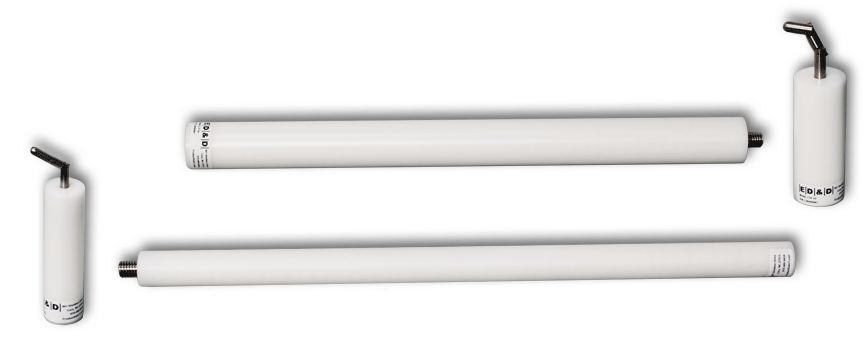
The Series CTF Jointed Child Finger Test Probes are age-specific accessibility probes used to evaluate whether a child could reach hazardous parts through openings, guards, or enclosures. Their reduced-size articulated geometries simulate child finger and arm access when the applicable safety requirement specifies a child probe.
CTF Model Selection
- CTF-01: simulates children from birth through 36 months of age
- CTF-02: simulates children from 3 through 14 years of age
- Jointed construction simulates finger articulation during accessibility checks
- Age-specific articulated probe geometry for applicable IEC-related procedures
Referenced standards: IEC 60335 and IEC 61032.
Selection note: age range alone does not determine the correct probe. Confirm the exact probe figure, dimensions, articulation, test force, and application procedure required by the governing product standard before selecting the CTF-01 or CTF-02.
TFP-01 Jointed Test Finger Probe — IEC 61032 Probe B

The TFP-01 Jointed Test Finger Probe is an international articulated test finger with a palm simulator, restricted joint movement, and continuity provision. It is the ED&D finger testing probe for procedures that specify IEC 61032 Probe B, Figure 2 geometry.
Product Details
- Jointed international test finger configuration
- Palm simulator
- Restricted joint movement
- Finger made of chrome-plated steel
- Body / instrument elements made of Delrin®
- Integral jack in the handle for continuity testing
- Geometry referenced to IEC 61032 Probe B, Figure 2
Referenced standards: IEC 60601, IEC 60950, IEC 61010, UL 60950, CSA 950, EN 61010, EN 60950, EN 60529, IEC 60529, and IEC 61032.
Continuity note: this model includes an integral handle jack for continuity testing in workflows where contact confirmation is required.
UFP-01 & UFP-02 Rigid Test Finger Probes
UFP-01 and UFP-02 are rigid test finger probes, also described as unjointed finger probes, for procedures that specify a non-articulating probe rather than a jointed test finger. The supplied product information references IEC-, CSA-, and UL procedures for this probe family.
Referenced standards: IEC 60601, IEC 60950, IEC 61010, IEC 61032, and UL 1450. Both models reference IEC 61032 Probe 11, Figure 7 geometry.
UFP-01 Rigid / Unjointed Finger Test Probe

- Rigid finger-probe configuration for procedures requiring force application
- Constructed from flash chrome-plated steel with Delrin® components
- Handle can be threaded for use with force gauges
UFP-02 Rigid / Unjointed Finger Test Probe

- Rigid finger-probe configuration for procedures requiring force application
- Constructed from stainless steel with Delrin® handle
- ISO/IEC 17025 accredited calibration certificate included
ULP-01 UL Finger Test Probe

The ULP-01 UL Finger Test Probe is an articulated UL-style test finger intended for product standards that specify UL finger geometry rather than IEC international test-finger geometry.
Product Details
- UL-style test finger configuration
- Palm simulator
- Restricted joint movement
- All-nylon construction
ULP-201 Articulated Metal UL Finger Test Probe
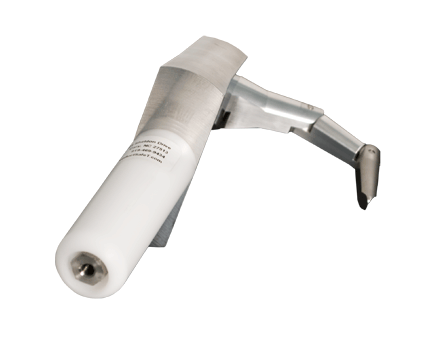
The ULP-201 Articulated Metal UL Finger Test Probe is intended for UL accessibility-testing procedures that specify this articulated metal test finger. It uses machined aluminum construction with a stainless steel probe tip.
Product Details
- Standard articulated UL finger-probe configuration
- Machined aluminum construction
- Stainless steel probe tip
- Electrical continuity provision to the tip
- NIST-traceable and ISO/IEC 17025 accredited calibration certificate included
Referenced procedure: UL product-safety methods that call for an articulated metal finger probe and require electrical contact confirmation through continuity to the probe tip.
Selection note: the ULP-201 should be selected only when the governing UL standard or test procedure specifies its geometry. Do not assume that it is interchangeable with the ULP-01 or an IEC articulated finger.
TFP-03 Jointed Finger Test Probe for Blenders

The TFP-03 is a jointed finger test probe intended for blender-related accessibility testing. It uses a larger circular stop face than the standard IEC test-finger arrangement.
Product Details
- Circular stop face diameter: 125 mm
- Distance from probe tip to stop face: 100 mm
- Specific articulated finger geometry
Referenced standards: IEC 60335.
TFP-04 Articulating Finger Test Probe

The TFP-04 uses an IEC articulating finger-probe configuration with a 50 mm circular stop face in place of the non-circular face found on other probe forms. It is intended for accessibility testing workflows that require this alternate stop-face arrangement.
Product Details
- IEC articulating finger-probe style
- Circular stop face: 50 mm diameter
- Alternative stop-face geometry relative to the more typical non-circular arrangement
- ISO/IEC 17025 accredited calibration certificate included
- 1-year warranty
TFP-1089 Jointed Finger Test Probe for GR-1089

The TFP-1089 is a jointed finger test probe intended for GR-1089 testing. It differs from typical IEC and UL probes by using a finger that is 10 mm longer and by omitting the simulated palm, while keeping the remaining dimensions aligned with IEC / UL-style geometry.
Product Details
- Constructed from Delrin® and flash chrome-plated steel
- Finger is 10 mm longer than standard IEC / UL-style probe versions
- No simulated palm
- Remaining dimensions aligned with IEC / UL-style geometry
- Special disk required by GR-1089 requirements
- Banana jack in the handle for continuity checking
- Calibration certificate included
FNP-01 Fingernail Test Probe

The FNP-01 Fingernail Probe checks the security of parts that snap together in appliance-related safety testing. It uses a spring-loaded handle arrangement that can be calibrated to the required force.
Product Details
- Used to check the security of snap-together parts
- Spring-loaded handle
- Spring loading can be calibrated to the required force
- Stainless steel construction
- Specially hardened tip
- Delrin® handle
Referenced standards: IEC 60335.
RAP-01 Rubber Accessibility Probe Kit
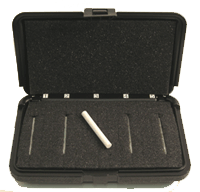
The RAP-01 supports modular-jack accessibility testing associated with UL 1863.
- Set of 5 identical probes
- Soft rubber construction
- Designed for modular-jack insertion testing
Related products are available under Specialty Test Probes.
Damaged probes should not be reused.
LVI-01 Electrical Contact Indicator
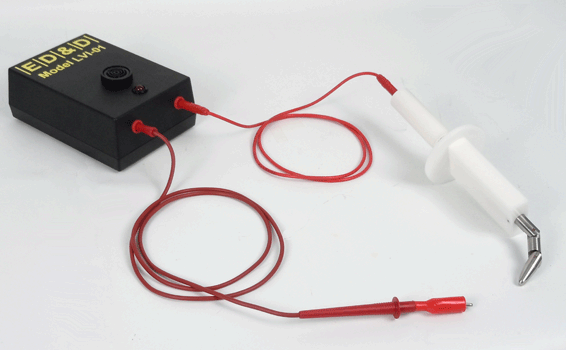
The LVI-01 Electrical Contact Indicator is used with the TFP-01 or another compatible probe when the applicable procedure requires electrical contact indication. Compatible probe sold separately.
- Transformer: 230 V / 42 V, 25 mA, 50–60 Hz
- Pilot lamp: 36–45 V / 2 W
- Includes 2 connecting leads and 2 tapping clips
- Other voltages available by request
The supplied product information references use with procedures associated with IEC 60335, IEC 61032, IEC 60529, IEC 60598, and EN 60335. Confirm the required contact-indication circuit against the applicable standard.
Finger Test Probe Frequently Asked Questions
What is a finger probe used for?
A finger test probe is used to verify whether hazardous live parts, moving parts, or protected internal areas can be reached through an opening, guard, or enclosure under the geometry and conditions defined by the governing safety standard.
Are “finger probe,” “test finger,” and “finger test probe” the same thing?
The terms are often used for the same general category of accessibility testing tools, and “finger testing probe” is another common search term. They do not mean that every model is interchangeable. The governing standard may require a specific jointed, articulated, rigid, unjointed, child, or UL test finger with defined dimensions, force, articulation, stop face, and continuity provisions.
What is the difference between a jointed and rigid finger probe?
A jointed or articulated test finger simulates finger movement so it can investigate an opening from different angles. A rigid or unjointed finger test probe is used when the procedure specifies a non-flexing probe or direct force application.
When should a lab use the TFP-01 instead of a UL finger probe?
The TFP-01 should be used when the standard calls for the international articulated finger configuration, such as IEC 61032 Probe B style, rather than a UL-specific finger design.
Why would a probe need continuity provision?
Continuity provision allows the lab to verify electrical contact when the probe reaches a hazardous part, which can be required in certain accessibility test workflows.
Are IEC 60950, EN 60950, and CSA 950 still relevant?
Yes, as legacy references. They remain relevant for older products, historical compliance files, and established lab procedures that still reference those standards.
Can one finger probe be used for every access test?
No. The required probe depends on the exact standard, figure, dimensions, articulation, stop face, force condition, and continuity requirements of the test method.
Which child finger probe should be used?
The CTF-01 simulates children from birth through 36 months, while the CTF-02 simulates children ages 3 through 14. Confirm the exact probe figure, dimensions, force, and procedure required by the governing standard.
Is the LVI-01 a finger probe?
No. The LVI-01 is an electrical contact indicator used with a compatible finger probe, such as the TFP-01, to determine whether the probe makes electrical contact within the product under test.
Tell us the exact standard and figure you need to test to, and whether your lab requires continuity provision, rigid insertion, or ISO/IEC 17025 accredited calibration.