Medical Device Safety Testing Equipment

ED&D medical device safety testing equipment supports repeatable evaluation of medical bed loading conditions, patient-activity simulation, and entrapment-risk assessment for hospital bed safety programs. This product family includes the MB-PAD Loading Pad Tester for Medical Beds and the EWT-01 Entrapment Wedge Tool for test workflows associated with IEC 60601-2-52 and the broader IEC 60601-1 medical electrical equipment framework.

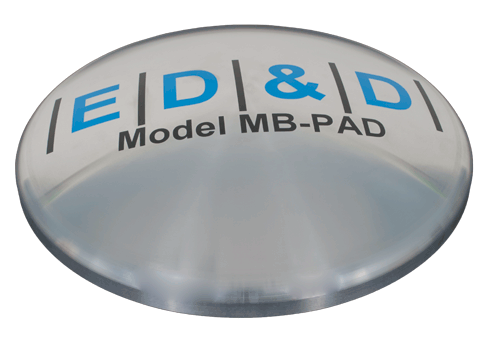
MB-PAD circular loading pad tester for medical bed patient simulation testing with a polished chrome finish
IEC 60601-2-52 IEC 60601-1 Medical Beds Entrapment Assessment Patient Activity Simulation

Built Around Medical Bed Safety
These tools are intended for hospital bed evaluation workflows where loading conditions and entrapment hazards must be assessed in a controlled, repeatable manner.

Method-Focused Tools
Medical bed testing is not just visual inspection. It requires defined loading conditions, repeatable geometry, and fixtures that align with the applicable bed-safety method.

Organized by Test Task
This page is grouped into loading simulation tools, entrapment-assessment tools, comparison guidance, FAQ, and applications to make product selection easier.

Request Medical Device Safety Test Equipment

Tell us the exact medical bed test, standard reference, and fixture requirement, and we can help identify the right ED&D tool for your program.

Medical Bed Safety Tools for Loading and Entrapment Evaluation

Medical device safety equipment in this category are intended for medical bed evaluation, where the test question is often mechanical rather than purely electrical. In practice, that can mean simulating patient activity, applying repeatable loading conditions, or assessing whether openings in a bed system create an unacceptable entrapment hazard.

ED&D’s medical bed safety tools focus on two distinct but related tasks. The MB-PAD Loading Pad Tester for Medical Beds is used to simulate patient activity and loading behavior during bed testing. The EWT-01 Entrapment Wedge Tool is used to assess the risk of neck entrapment in V-shaped openings in medical beds.

These products are positioned around IEC 60601-2-52, the particular standard for the basic safety and essential performance of medical beds intended for adults, along with the broader IEC 60601-1 medical electrical equipment framework that underpins those evaluations. For bed-related product testing, the exact clause, annex figure, patient-support configuration, and opening geometry all matter to the final assessment.

Important standards note: these tools support the test method, but they do not replace the governing standard. Final compliance depends on the exact bed configuration, test setup, opening location, loading arrangement, and the specific requirements of the applicable medical bed standard.

How This Page Is Organized

  • Loading Simulation Tools: tools used to simulate patient activity and applied load conditions during medical bed testing
  • Entrapment Assessment Tools: tools used to evaluate openings associated with neck-entrapment risk in medical beds

Loading Simulation Tools for Medical Bed Testing

MB-PAD Loading Pad Tester for Medical Beds

MB-PAD circular loading pad tester for medical bed patient simulation testing with a polished chrome finish

MB-PAD Loading Pad Tester for Medical Beds is used for simulating patient activity during medical bed testing. It is intended for safety programs where repeatable loading conditions are needed to evaluate bed behavior, support-system response, and related mechanical safety considerations under the applicable test method.

In practice, loading pad tools are valuable when the test requires a defined interface between the applied load and the bed surface, rather than an improvised loading arrangement that can reduce repeatability from one test to the next.

Positioned for workflows associated with IEC 60601-2-52 medical bed evaluation and the broader IEC 60601-1 framework for medical electrical equipment safety.

Loading-tool note: bed loading methods are most useful when the applied force, contact area, and placement are consistent from test to test. A dedicated loading pad helps make that setup more repeatable.

Entrapment Assessment Tools for Medical Beds

EWT-01 Entrapment Wedge Tool

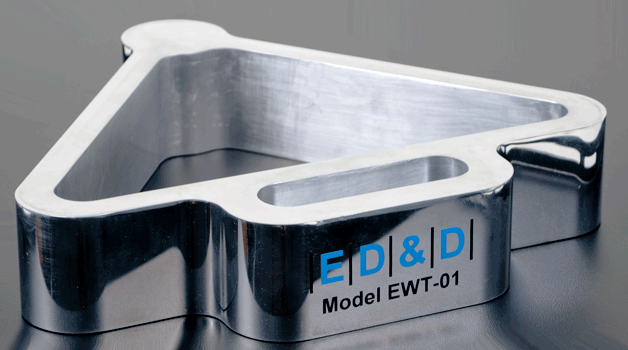
EWT-01 entrapment wedge tool precision-machined from polished aluminum for assessing neck entrapment risks in medical bed V-shaped openings

EWT-01 Entrapment Wedge Tool is used for assessing the risk of neck entrapment in V-shaped openings in medical beds. It is precisely manufactured from polished aluminum for repeatable use in medical bed safety evaluations where opening geometry is part of the hazard assessment.

Based on your supplied product information, the EWT-01 is aligned with IEC 60601-2-52, Annex CC, Figure CC.1, for the assessment of V-shaped opening conditions in medical bed systems.

This tool is especially valuable where the test method requires a defined wedge geometry rather than a judgment-based visual inspection of the opening.

Entrapment note: opening assessment depends on the exact location, orientation, and configuration of the bed system under test. The wedge tool supports a repeatable method, but the full evaluation still depends on applying the governing procedure correctly.

Which Medical Device Safety Tester Is Right for Your Lab?

Product Primary Use Best Fit Key Advantage
MB-PAD Patient-activity simulation Medical bed loading and support-condition evaluation Provides a more repeatable loading interface for bed test workflows
EWT-01 Entrapment assessment V-shaped opening checks in medical beds Defined wedge geometry for repeatable opening evaluation

Selection guidance: choose the MB-PAD when the method requires simulated patient loading or activity, and choose the EWT-01 when the concern is evaluating V-shaped openings for neck-entrapment risk in medical beds.

Frequently Asked Questions

What standard is most relevant to these products?

The main standards anchor is IEC 60601-2-52 for medical beds, used together with the broader IEC 60601-1 framework for medical electrical equipment safety.

What does the MB-PAD do?

It is used to simulate patient activity and applied loading conditions during medical bed testing, helping the lab create a more controlled and repeatable setup.

What does the EWT-01 measure?

It is used to assess the risk of neck entrapment in V-shaped openings in medical beds where the applicable method calls for wedge-based opening evaluation.

Are these products only for electrically powered beds?

They are positioned around medical bed safety evaluation workflows. Final applicability depends on the bed type, the governing clause, and whether the product under test falls within the scope of the applicable medical bed standard.

Why is a dedicated tool better than an improvised fixture?

Because repeatable geometry and controlled loading are essential to trustworthy results. A dedicated fixture reduces variability and aligns the setup more closely with the intended method.

Do these tools determine compliance by themselves?

No. They support the required test setup. Final compliance depends on the full standard, the exact product configuration, and correct execution of the method.

Talk to ED&D About Medical Device Safety Equipment

Send the bed type, required test method, and applicable standard reference, and we can help identify the right loading or entrapment tool.

Typical Medical Bed Safety Applications

ED&D medical device safety equipment are used in medical device laboratories, hospital bed development programs, certification test environments, and engineering validation workflows where bed safety must be evaluated using repeatable fixtures and defined geometry.

Depending on the exact workflow, these applications may involve IEC 60601-2-52 medical bed evaluation and the broader IEC 60601-1 medical electrical equipment safety framework.

  • Simulation of patient activity on medical beds
  • Repeatable loading conditions during bed safety evaluation
  • Support-surface and bed-configuration testing workflows
  • Assessment of V-shaped openings in bed systems
  • Neck-entrapment risk evaluation using defined wedge geometry
  • Bench-top fixture support for medical bed hazard review
  • Internal engineering validation of bed designs
  • Third-party lab preparation and repeatability support
  • Documentation-focused medical bed test workflows

Method note: meaningful results depend on using the correct bed configuration, opening location, load placement, and standard-defined procedure for the product under test. Fixture accuracy supports the method, but it does not replace it.