
Flexing & Cable Test Equipment
ED&D flexing and cable test equipment includes equipment for cord anchorage torque testing and continuous cable bending and flexing tests of electrical appliances, flexible cords, cord sets, hand-held tools, and related products. This page covers the F20 Cord Anchorage Torque Device and the Series F39 Cable Flexing Test System for applications identified in the supplied product information with IEC 60335, IEC 60227, IEC 60745, and UL 745.
Provide the standard and clause, specimen type, cable construction and diameter, required motion, loading arrangement, and clamping requirements.
Flexing and Cord Anchorage Testing
Flexing and cable test methods may apply a defined torque at a cord anchorage or repeated bending and swivel motion to a flexible cable or cable assembly. The required equipment depends on the applicable standard, clause, specimen construction, loading arrangement, clamping requirements, and test motion.
The F20 Cord Anchorage Torque Device is used for torque-resistance testing of non-detachable flexible cords. The Series F39 Cable Flexing Test System is used for repeated bending and flexing of flexible cables, cord sets, power cords, tools, appliances, and related cable assemblies.
Standards note: confirm the test motion, conductor loading, clamping arrangement, torque, specimen preparation, and cycle conditions required by the applicable standard and clause.
F20 Cord Anchorage Torque Device
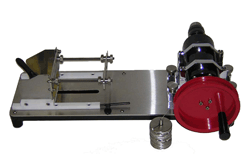
The F20 Cord Anchorage Torque Device tests the resistance to torque of cord anchorages on electrical appliances with non-detachable flexible cords. The supplied product information lists cord diameters up to 10 mm and torque values up to 0.5 Nm.
Product Details
- For electrical appliances with non-detachable flexible cords
- Cord diameter up to 10 mm
- Torque capacity up to 0.5 Nm
- Total length approximately 600 mm
- Height approximately 160 mm
- The supplied product information references IEC 60335
Construction: the base plate and bearing component have a papyrus-white textured finish. The fastening device and other parts are browned, nickel-plated, or stainless steel, as described in the supplied product information.
Confirm the required cord diameter, torque, and appliance anchorage configuration before specifying the F20.
Series F39 Cable Flexing Test System
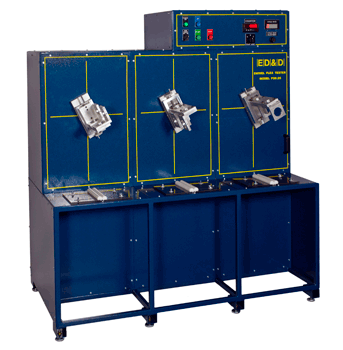
The Series F39 Cable Flexing Test System subjects flexible cables, cord sets, power cords, tools, appliances, and related cable assemblies to repeated bending and flexing motion.
Configuration depends on the applicable method, cable construction, specimen geometry, loading arrangement, clamping requirements, and test motion.
Product Details
- For repeated bending and flexing of flexible cables and cable assemblies
- Test setup is selected according to the applicable standard and clause
- Associated with IEC 60335, IEC 60227, IEC 60745, and UL 745
Confirm the exact standard and clause, specimen type, cable construction, loading arrangement, clamping requirements, and test motion before specifying a Series F39 system.
Frequently Asked Questions
What is the difference between cord anchorage testing and cable flexing testing?
Cord anchorage testing evaluates resistance to applied torque at the appliance cord entry. Cable flexing testing subjects the cable assembly to repeated bending or swivel motion.
What does the F20 torque device test?
The F20 tests the resistance to torque of cord anchorages on electrical appliances with non-detachable flexible cords.
What does the Series F39 test system do?
The Series F39 subjects flexible cables and cable assemblies to repeated bending and flexing motion.
Can the Series F39 be configured for different cable tests?
Yes. The configuration depends on the required method, cable construction, specimen geometry, loading arrangement, clamping requirements, and test motion.
Can one machine cover every cable test method?
No. Different standards may require torque, bending, swivel motion, conductor loading, or different clamping arrangements, so the required equipment depends on the exact method.
Provide the standard and clause, specimen type, cable construction and diameter, required motion, loading arrangement, and clamping requirements.