
Comparative Tracking Index (CTI) Testers
ED&D Comparative Tracking Index testers evaluate the resistance of solid insulating materials to surface tracking under controlled electrical stress and contaminant exposure. Available models support IEC 60112, UL 746A-related material evaluations, and ASTM D3638 testing, with model-specific options for automated drop delivery, camera observation, data acquisition, and test documentation.

IEC and ASTM Configurations
Select an IEC-focused tester or a dual IEC 60112 and ASTM D3638 configuration.
Controlled Test Functions
Model-dependent features include drop delivery, electrode assemblies, voltage adjustment, current limiting, camera observation, and data acquisition.
Engineering Applications
CTI and PTI results support material comparison and the application of material data within product safety standards.
Provide the governing standard, specimen material, required voltage range, and documentation requirements.
CTI and PTI Testing of Solid Insulating Materials
Comparative Tracking Index testing compares the resistance of solid insulating materials to the formation of a conductive carbonized path on the specimen surface. The method applies electrical stress while a prescribed conductive solution is delivered between two electrodes.
IEC 60112 covers both Comparative Tracking Index (CTI) and Proof Tracking Index (PTI). CTI establishes a comparative index through testing at multiple voltage levels, while PTI determines whether a material withstands a specified test voltage under the prescribed conditions.
Product safety engineers use CTI and PTI data when evaluating insulating materials, assigning material groups, determining creepage-distance requirements, and reviewing material suitability within the applicable product standard. ED&D offers four tester configurations with different control, observation, and documentation capabilities.
Method note: the tester is one part of the complete method. Valid results also depend on specimen preparation, electrode geometry and condition, test-solution preparation, drop delivery, electrical settings, and the endpoint criteria required by the governing standard.
CTI Tester Model Comparison
| Model | Primary Standards | Configuration | Key Features |
|---|---|---|---|
| TRK-01 | IEC 60112 and UL 746A-related workflows | Digital CTI / PTI tester | Electronic drop control, drop counter, adjustable current limiting, and adjustable test voltage |
| TRK-01-ASTM | IEC 60112 and ASTM D3638 | Dual-standard camera and data-acquisition system | Integrated camera, specialized optics, workstation, operating mode selector, and current-versus-voltage data logging |
| TRK-02 | IEC 60112 and product standards that reference CTI or PTI results | Integrated automated CTI / PTI tester | Platinum electrodes, automated fluid dispensing, drop counting, adjustable voltage, current limiting, and interlocked dome |
| TRK-02-ASTM | IEC 60112 and ASTM D3638 | Dual-standard camera and data-acquisition system | Camera system, workstation, data acquisition, serial outputs, and external safety outputs |
Configuration considerations: select the model according to the governing method, required voltage range, electrode and drop-delivery requirements, observation needs, data outputs, and facility safety requirements.
TRK-01 Digital Comparative Tracking Index Tester
The TRK-01 Digital Comparative Tracking Index Tester evaluates the resistance of solid insulating materials to surface tracking. It provides the principal test functions required to apply a controlled conductive solution between electrodes while the specimen is subjected to the selected electrical conditions.
Product Details
- Electrode assembly for CTI and PTI testing
- Electronic control for conductive-drop release
- Integrated drop counter
- Adjustable current limiting
- Adjustable test voltage to 600 V
- 1000 V configuration available
- Stainless-steel construction
- Available for 120 V or 240 V supply
Standards application: intended for IEC 60112 CTI / PTI testing and UL 746A-related material-evaluation workflows.
Ordering note: specify the required supply voltage, maximum test voltage, test method, and calibration requirements when requesting a quote.
TRK-01-ASTM Comparative Tracking Index Tester
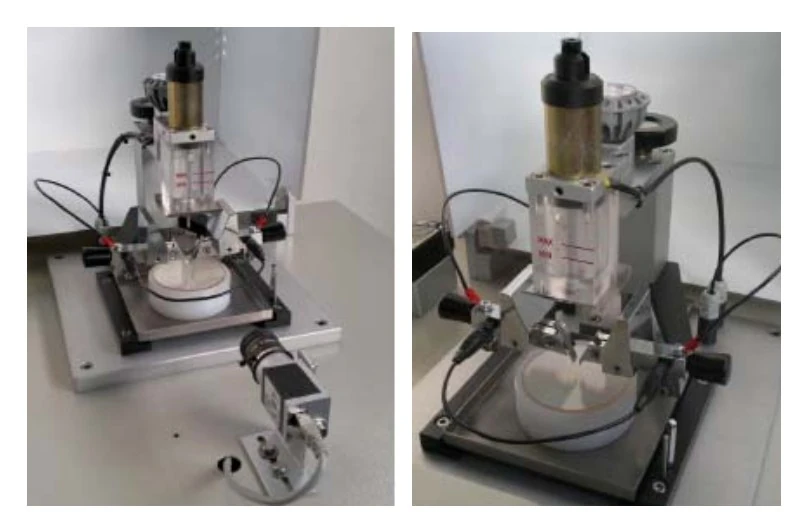
TRK-01-ASTM electrode assembly and integrated camera system.
The TRK-01-ASTM adds integrated camera observation, data acquisition, and IEC / ASTM operating modes to the TRK-01 platform for laboratories performing both IEC 60112 and ASTM D3638 testing.
Product Details
- Integrated high-resolution digital camera
- Specialized optics for observing carbon-path formation
- Workstation with National Instruments Vision software
- Front-panel IEC / ASTM operating mode selector
- Current-versus-voltage data logging
- Adjustable over-current trip settings from 0.1 A to 1.0 A
- 0.5-second trip time
Recommended when: choose the TRK-01-ASTM when the laboratory requires both IEC 60112 and ASTM D3638 operating modes with integrated visual observation and data logging.
TRK-02 Comparative Tracking Index Tester
The TRK-02 is an integrated tester for determining the Comparative Tracking Index and Proof Tracking Index of solid electrical insulating materials under IEC 60112 and product standards that reference CTI or PTI results.
Product Details
- High-purity platinum electrodes
- Electrodes positioned at 60° with 1 N applied force
- Automated fluid dispenser delivering 20 mm³ drops at 30-second intervals
- Preselection drop counter
- Interlocked safety dome
- Adjustable test voltage to 600 V AC
- Adjustable current limiting
- Over-current trip setting of 0.5 A with a 2-second delay
- NIST-traceable calibration available
- ISO/IEC 17025 accredited calibration available for applicable measurements
Standards application: intended for IEC 60112 testing and product standards that reference CTI or PTI results, including applicable IEC 60335 evaluations.
TRK-02-ASTM Comparative Tracking Index Tester
The TRK-02-ASTM combines the TRK-02 test frame, automated drop-delivery system, and platinum electrode assembly with a dedicated camera, data-acquisition software, and workstation for IEC 60112 and ASTM D3638 testing.
Product Details
- CTI / PTI test frame
- Automated drop-delivery system
- Platinum electrode assembly
- Dedicated camera system
- Data-acquisition software
- Bundled workstation
- IEC and ASTM operating modes
- Current-versus-voltage data logging
- Serial outputs for voltmeter, ammeter, and drop-counter data
- External safety outputs for facility fire-protection integration
Recommended when: choose the TRK-02-ASTM when the laboratory requires the automated TRK-02 platform together with ASTM D3638 capability, camera observation, and expanded data outputs.
TRK-CM1 Conductivity Meter
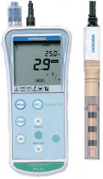
The TRK-CM1 Conductivity Meter is an accessory for checking and documenting the conductive solution used during CTI testing. It measures conductivity, resistivity, and salinity and can support solution-preparation checks, troubleshooting, and laboratory records.
Included Equipment and Functions
- Portable waterproof meter
- Conductivity, resistivity, and salinity measurements
- Automatic data logging
- Self-diagnostic function
- PC and printer output
- Model 9382-10D electrode
- Soft case, strap, batteries, and instruction manual
Accessory note: the conductivity meter verifies solution condition; it does not replace the CTI tester or the method controls for electrodes, drop delivery, electrical settings, specimen preparation, and endpoint determination.
CTI Tester Applications
ED&D CTI testers are used by materials laboratories, product safety laboratories, manufacturers, certification organizations, and engineering groups that evaluate the tracking resistance of solid insulating materials.
- IEC 60112 CTI and PTI testing
- ASTM D3638 material testing with ASTM-configured models
- UL 746A-related polymeric-material evaluation
- Material grouping for insulation coordination
- Creepage-distance design decisions
- Comparison of candidate insulating materials
- Incoming-material and quality-control testing
- Product development and material qualification
- Investigation of tracking-related surface degradation
Application note: CTI or PTI data must be applied according to the governing product standard and the material-grouping or insulation-coordination rules relevant to the product under evaluation.
Frequently Asked Questions
What is CTI testing used for?
CTI testing compares the resistance of solid insulating materials to surface tracking under prescribed electrical and contaminant conditions. The resulting data supports material grouping, insulation coordination, creepage-distance decisions, and material selection.
What is the difference between CTI and PTI?
CTI establishes a comparative tracking index by testing a material at multiple voltage levels. PTI determines whether a material withstands a specified test voltage under the prescribed IEC 60112 conditions.
Which ED&D models support ASTM D3638?
The TRK-01-ASTM and TRK-02-ASTM are configured for both IEC 60112 and ASTM D3638 testing. They add IEC / ASTM operating modes, camera observation, and data-acquisition features to their respective base platforms.
What voltage range is available?
The standard TRK-01 and TRK-02 configurations provide adjustable test voltage to 600 V. A 1000 V TRK-01 configuration is also available.
What do the camera-equipped models document?
The ASTM-configured models provide camera observation of the specimen and electrode area during testing. Their data-acquisition systems also support model-specific logging and correlation of electrical test parameters.
Is the TRK-CM1 conductivity meter required?
The TRK-CM1 is an optional support instrument for laboratories that want to check and document conductive-solution condition. Whether it is required depends on the governing method, laboratory procedure, and quality-system requirements.
Include the governing standard, specimen material, required voltage range, observation requirements, data outputs, and calibration requirements.