
Impact Test Equipment
ED&D impact test equipment applies defined mechanical impacts to enclosures, components, appliance parts, and product assemblies. Available equipment includes pendulum apparatus, appliance-specific testers, spring-operated impact hammers, and hardened impact balls for methods associated with IEC, UL, and other product-safety standards.

Tell us the exact standard, clause, specimen type, required impact energy or mass, and whether your lab needs a pendulum apparatus, appliance-specific tester, spring hammer, or impact ball.
Impact Testing for Enclosures, Components, and Safety Verification
Impact testing evaluates how an enclosure, component, or product responds to a defined mechanical strike. The applicable method may require a pendulum apparatus, an appliance-specific fixture, a spring-operated impact hammer, or a hardened steel impact ball.
Equipment selection depends on the required impact method, energy, mass, striking-face geometry, hardness, specimen support, and calibration requirements specified by the governing standard or procedure.
Method requirements: confirm the applicable edition and clause before testing. The impact tool, energy or mass, geometry, specimen support, impact locations, number of impacts, conditioning, and calibration state must match the required procedure.
PIH-1J Pendulum Impact Hammer
PIH-1J Swing Pendulum / Impact Test Apparatus
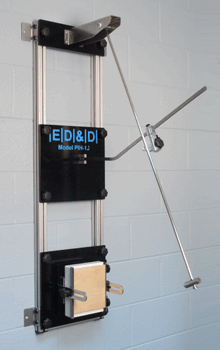
The ED&D PIH-1J is a fixed-energy 1 J pendulum impact apparatus for evaluating the response of accessible product surfaces, enclosures, covers, and similar parts to a defined pendulum impact.
It is used for the pendulum hammer method specified in IEC 60068-2-75 and is used for product-safety requirements appearing in standards such as IEC 60335, IEC 60065, IEC 60745, IEC 61029, and IEC 60950.
Provides a dedicated 1 joule swing-pendulum impact arrangement when the required method or specimen configuration is not suitable for a handheld spring hammer.
PIH-1J Test Positioning
- Impact method: swing pendulum / pendulum hammer
- Nominal impact energy: 1 J
- Primary reference: IEC 60068-2-75 pendulum hammer method
- Typical specimens: accessible surfaces, covers, enclosures, and product assemblies
- Test arrangement: fixed apparatus geometry for specimens that cannot be tested appropriately with a handheld spring hammer
Standards note: confirm the exact edition, clause, impact point, specimen support, number of impacts, and acceptance criteria required by the applicable product standard.
Appliance-Specific Impact Testers
Some appliance standards require a defined test object, mass, contact surface, drop procedure, or specimen arrangement rather than a general-purpose pendulum or spring hammer. The ITA-05 and ITA-858 are used for these product-specific procedures.
ITA-05 Appliance Lid Impact Tester
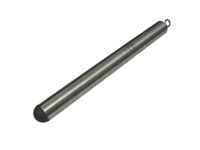
The ED&D ITA-05 is intended for impact testing the lids of appliances in accordance with the applicable requirements of IEC 60335-2-4, Clause 21.101.
The apparatus reproduces the prescribed impact arrangement used to evaluate whether a lid and its supporting structure withstand the mechanical stresses addressed by the governing appliance standard.
Used for covered appliances within the applicable scope of IEC 60335-2-4, including spin extractors and washing machines.
ITA-858 Copper Impact Tester
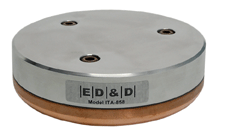
The ED&D ITA-858 is a circular, copper-bottomed 3.96 lb. (1.8 kg) impact weight used for repeated-drop impact testing of glass or ceramic panels.
Its rounded copper contact surface is designed to simulate the impact of a cooking utensil on a household cooking surface. The tester is used for impact procedures associated with UL 858, the active standard for household electric ranges.
Used for repeated-drop impact evaluation of glass-ceramic cooktops, range surfaces, and related household cooking-equipment panels.
Edition and clause note: product standards change over time. Confirm the current edition, exact clause, drop height, number and location of impacts, specimen conditioning, support arrangement, and acceptance criteria before testing.
Spring-Operated Impact Hammers
F22.50 Impact Hammer
Adjustable impact hammer with selectable energy levels from 0.20 J to 1.0 J for defined mechanical impact testing.
Series 5110 Spring-Operated Impact Hammers
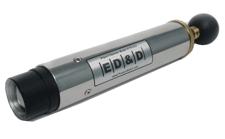
Single-energy spring-operated impact hammers for methods requiring a defined impact value.
Available from 0.20 J to 2.0 J with calibration certificate and carrying case.
Impact Test Balls
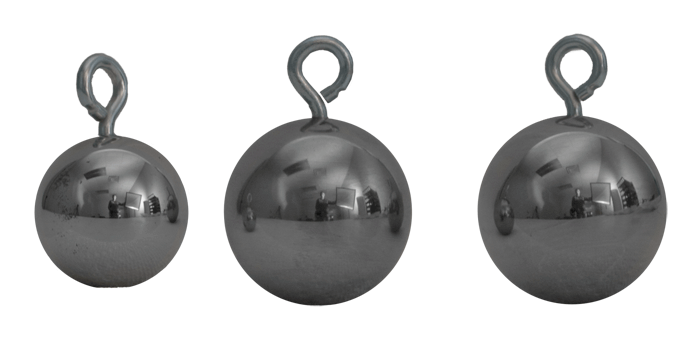
The Series ITB Impact Test Balls are hardened steel ball-impact tools used in methods that call for a defined ball diameter, mass, and in some cases a specified hardness. They are used in drop, pendulum, and related ball-impact procedures where the standard defines the exact ball characteristics rather than a spring-operated hammer energy.
Certain ITB models include a removable eyelet so the ball can be used in either drop-style or pendulum-style arrangements depending on the lab setup and the governing procedure.
Required information: select the impact ball using the exact required diameter, weight, hardness, and mounting method called for by the applicable standard or clause.
Series ITB Reference Table
| Model | Referenced Standards | Diameter | Mass / Weight | Construction / Configuration |
|---|---|---|---|---|
| ITB-01 | IEC 60950 | 50 mm | 500 g | Hardened steel with chrome finish; removable eyelet for drop or pendulum use |
| ITB-03 | UL 1989, UL 1418, and others | 2 inches | 1.18 lb. | Variant ball configuration for standards requiring inch-based size and weight conventions |
| ITB-04 | IEC 60065, Clause 18.2.3 | 40 mm | Per method | Minimum Rockwell Hardness R65 for methods requiring a smaller hardened ball |
Frequently Asked Questions
What is the difference between an impact hammer and an impact test ball?
An impact hammer delivers a defined spring-operated strike at a specified energy level, while an impact test ball is used in methods that specify a ball of defined diameter, mass, and sometimes hardness for drop, pendulum, or ball-impact testing.
When should a lab choose the adjustable F22.50 instead of a Series 5110 hammer?
Choose the F22.50 when your lab needs multiple impact-energy levels in one tool. Choose a Series 5110 model when the method calls for one specific fixed energy and you want a dedicated hammer for that value.
Why do impact test balls have different diameters and hardness levels?
Because different standards call for different impact masses, dimensions, and hardness requirements. The correct ball must match the exact clause used in the test method.
When should a lab use the PIH-1J instead of a spring impact hammer?
Use the PIH-1J when the governing method requires a pendulum-hammer arrangement at 1 J, or when the specimen geometry and support arrangement make a handheld spring hammer inappropriate. A spring hammer should be selected when the applicable clause specifically requires that method.
What is the ITA-05 used to test?
The ITA-05 is intended for impact testing appliance lids under the product-specific arrangement addressed by IEC 60335-2-4, Clause 21.101. The applicable edition and exact test conditions should be confirmed before use.
Why does the ITA-858 use a copper-bottomed 1.8 kg weight?
The circular copper bottom represents the contact characteristics of a cooking utensil, while the calibrated 3.96 lb. (1.8 kg) mass provides the prescribed impact body for repeated-drop durability testing of glass or ceramic cooking panels under the applicable procedure.
What calibration information is required for impact testing?
The calibration record should address the characteristics required by the applicable method, including impact energy and striking geometry where applicable. Confirm the required calibration and traceability provisions in the governing standard or laboratory procedure.
Can one impact tool cover every standard?
No. Different standards may call for a specific hammer energy, ball size, hardness level, or test arrangement, so the correct tool depends on the exact method.
Send the exact standard, clause, specimen type, and required impact method, to identify the required pendulum apparatus, appliance-specific tester, spring hammer, or impact ball.